


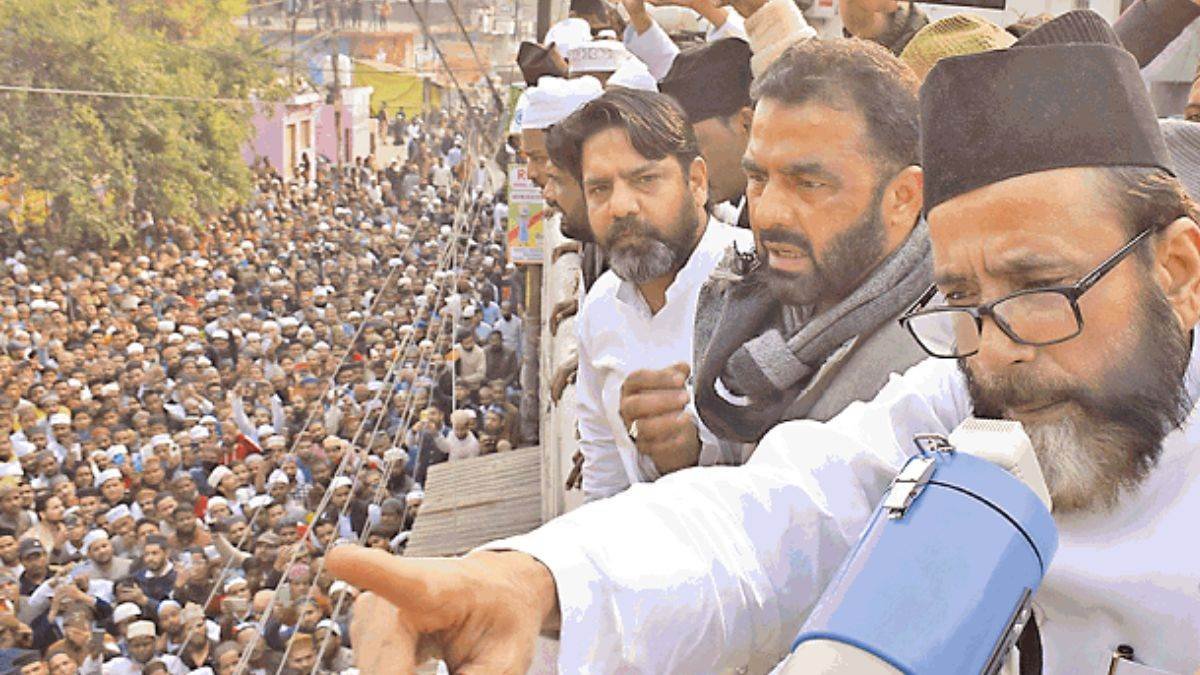
Maulana Tauqeer Raza Khan, head of the Ittehad-e-Millat Council (IMC) and a prominent Muslim cleric from Bareilly, Uttar Pradesh, was arrested on Saturday in connection with the controversial “I Love Muhammad” campaign. His detention has ignited debates over religious expression, minority rights, and state policing under the Yogi Adityanath government.
Early Life and Background
Tauqeer Raza Khan hails from Bareilly, a city known as the stronghold of the Barelvi Islamic movement, founded by his great-grandfather, Ahmed Raza Khan Barelvi (Ala Hazrat). Belonging to the influential Raza Khan family, Tauqeer Raza grew up deeply rooted in Islamic scholarship and religious tradition.
-
Lineage: Great-grandson of Ala Hazrat, the 19th-century Islamic scholar and jurist who founded the Barelvi school of Sunni Islam.
-
Community Role: Holds the title of Naqeeb-e-Millat, making him a recognized leader within the Barelvi sect.
-
Education: Trained in Islamic studies, Quran, and Hanafi jurisprudence, continuing the family’s scholarly legacy.
Marriage and Family Life
Maulana Tauqeer Raza Khan is married and has a family based in Bareilly. While he has largely kept his personal life private, his family background in the Barelvi movement has ensured that religious leadership runs through generations. His marriage has been described as stable, with relatives and family members often involved in community leadership and welfare initiatives.
Professional & Political Journey
Religious Role
As a cleric, Raza delivers sermons, leads prayers, and issues statements on matters of Islamic law, Muslim identity, and communal harmony. His speeches and campaigns often combine theology with contemporary issues, giving him a wide following among Barelvi Muslims.
Political Role
In 2001, he founded the Ittehad-e-Millat Council (IMC), a political outfit that works on issues concerning Muslim rights, representation, and welfare.
-
The party has contested Uttar Pradesh assembly elections but has not yet secured major victories.
-
Tauqeer Raza has allied with both Congress and Samajwadi Party in the past, highlighting his role as a negotiator for Muslim political interests.
-
He is known for fiery rhetoric, often clashing with ruling parties over policies he sees as discriminatory against Muslims.
The “I Love Muhammad” Campaign and His Arrest
The Campaign
The “I Love Muhammad” campaign began earlier in September 2025 when boards and posters carrying the slogan appeared during Eid-e-Milad-un-Nabi processions in Kanpur and Bareilly.
-
On September 9, Kanpur police filed an FIR against 24 individuals for displaying “I Love Muhammad” posters during processions.
-
The campaign spread across Uttar Pradesh, Uttarakhand, and Karnataka, sparking objections from some Hindu groups.
-
AIMIM chief Asaduddin Owaisi defended the campaign, arguing that “expressing love for Prophet Muhammad is not a crime.”
The Bareilly Incident
On September 26, after Friday prayers, large crowds gathered outside a mosque in Bareilly’s Kotwali area carrying “I Love Muhammad” posters.
-
Police say the gathering was unauthorized and turned violent, with clashes, stone-pelting, and injuries to officers.
-
According to police, weapons, glass bottles, and stones were recovered from the site.
-
Over two dozen people were detained, and internet services in Bareilly were suspended for 48 hours.
Arrest and Custody
-
On September 27, Tauqeer Raza Khan was arrested and sent to 14 days’ judicial custody.
-
Bareilly SSP Anurag Arya confirmed the arrest, stating: “Legal proceedings are ongoing, and the situation remains under control.”
Maulana Raza’s Response
In a video statement released the night before his arrest, Raza challenged the police narrative:
-
He claimed he was placed under house arrest to prevent him from addressing supporters or submitting a memorandum to the District Magistrate.
-
The memorandum reportedly sought Presidential intervention over alleged attacks on Muslims.
-
He alleged that a fake letterhead bearing his name had been circulated to spread false statements, worsening tensions.
-
He accused police of targeting Muslims, using lathis (batons), and making false accusations against the community.
“The more police suppress religious sentiments, the stronger they will rise. There is no Hindu-Muslim conflict—only police high-handedness is to blame,” he said.
Raza also urged his followers to remain peaceful, even as he warned that continued suppression of Muslim sentiments could have serious repercussions.
State Government’s Position
The Yogi Adityanath government has described the Bareilly unrest as a “planned conspiracy”.
-
CM Yogi Adityanath stated that “lawbreakers will face strict action” and warned clerics against attempting to mobilize crowds without permission.
-
In a hardline remark, Yogi said: “Denting and painting must be done,” widely interpreted as a warning of severe consequences for repeat offenders.
Political and Social Reactions
-
AIMIM chief Asaduddin Owaisi has come out in defense of the campaign, calling the arrest of Raza “an attack on religious freedom.”
-
Muslim organizations across UP have expressed concern over what they see as selective targeting of Muslim leaders.
-
Hindu groups supporting the government argue that the campaign was a deliberate attempt to provoke sentiments.
Broader Implications
The arrest of Maulana Tauqeer Raza Khan highlights:
-
Tensions over religious expression in Uttar Pradesh.
-
Policing of public gatherings and state crackdowns on perceived provocative campaigns.
-
Polarization in electoral politics, with minority leaders caught between community expectations and government control.
As the legal process continues, Raza’s arrest is likely to deepen debates about faith, freedom, and state authority in India’s most populous state.
Conclusion
Maulana Tauqeer Raza Khan’s life has always intertwined religion, politics, and controversy. From being the great-grandson of Ala Hazrat to founding the Ittehad-e-Millat Council, he has positioned himself as both a cleric and a political voice for Muslims in Uttar Pradesh.
His arrest in the “I Love Muhammad” campaign has once again brought him to the center of national attention—raising tough questions about the limits of religious expression, the conduct of police, and the political climate in Yogi Adityanath’s Uttar Pradesh.